Silica (SiO$_{2}$) and Aluminum Phosphate (AlPO$_{4}$)
Silica (SiO$_{2}$), aluminum phosphate (AlPO$_{4}$) and related compounds all consist of nearly regular M-O$_{4}$ tetrahedra (Fig. 1) with the “metallic” atom at the center, and each vertex of the tetrahedron connected to another tetrahedron. In aluminum phosphates the AlO$_{4}$ tetrahedra are all connected to PO$_{4}$ tetrahedra, and visa versa (Fig.2). The tetrahedra are relatively rigid, with the M-O and O-O bond distances approximately equal, and the O-M-O bond angle near the ideal value of 109.47°. The tetrahedra can be tilted relative to one another. The amount of tilting can be described by the angle M1-O-M2, where M1 and M2 are the metallic atoms in the two tetrahedra connected by the oxygen atom. In β-cristobalite (C9) this angle is 180°, but it can range from 132° to 180° in AlPO$_{4}$-8.
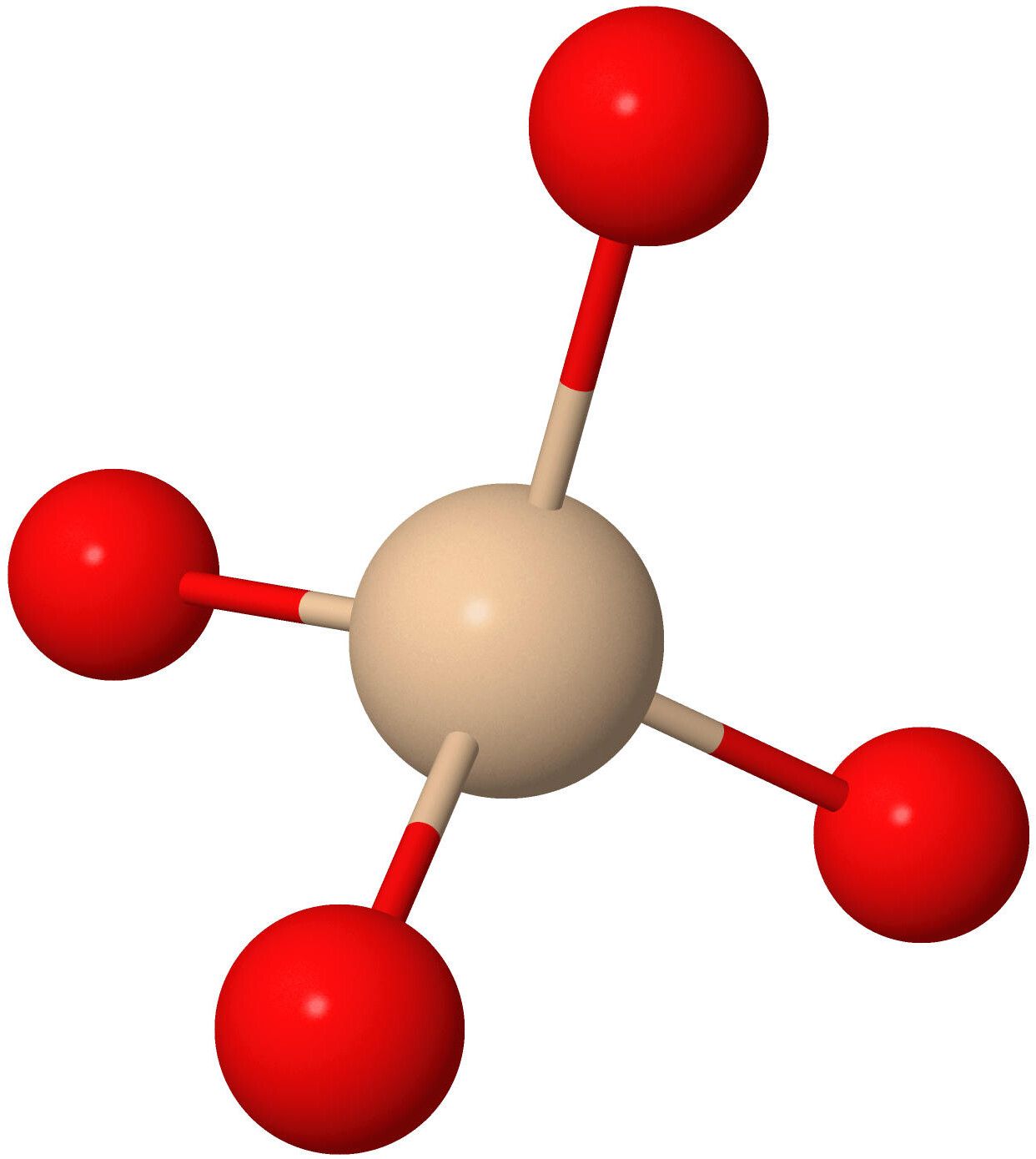
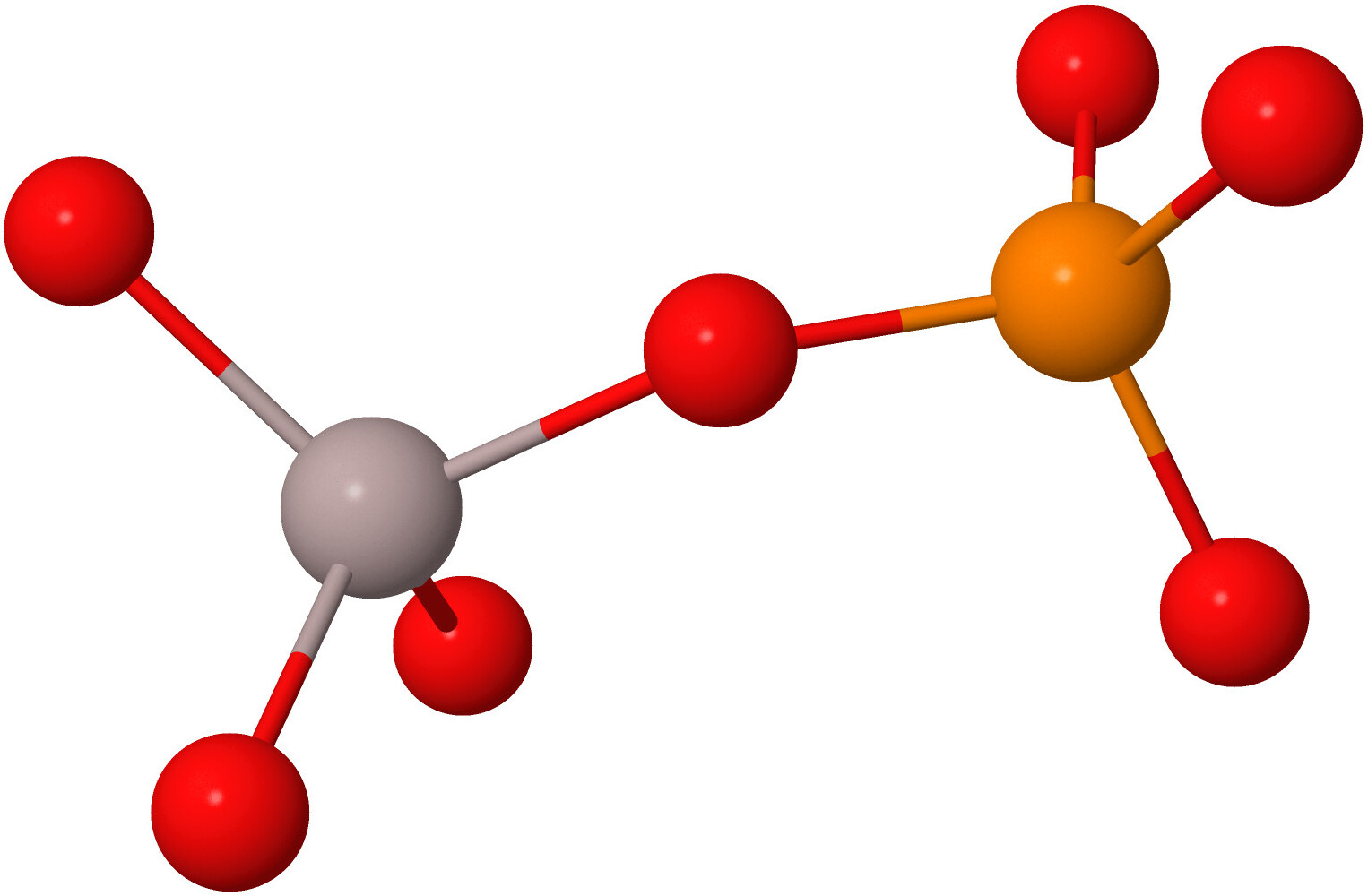
Right: Linked AlO$_{4}$ and PO$_{4}$ tetrahedra from the low cristobalite from of AlPO$_{4}$. The PO$_{4}$ tetrahedron is nearly perfect, but the AlO$_{4}$ tetrahedron has O-O distances ranging from 2.72Å to 2.77Å. The Al-O-P angle in 146.4°. Each oxygen atom on the left connects to a phosphorous atom, while each oxygen on the right connects to an aluminum atom.
Because of the nearly-perfect nature of the SiO$_{4}$ tetrahedra many silica crystal structures are more or less compact, as in the ideal β-cristobalite (Strukturbericht $C9$) structure (Wyckoff, 1925; Peacor, 1973) shown on the left in Fig. 2. The mismatched SiO$_{4}$/AlPO$_{4}$ tetrahedra, on the other hand, can lead to extremely open structures, perhaps most dramatically illustrated by the structure known as AlPO$_{4}$-5 (Klap, 2000), which has open channels formed by Al-O-P-O rings about 9.9Å in diameter, as shown in Figure 3. These wide channels allow AlPO$_{4}$ structures to be used as molecular sieves (Wilson, 1982).
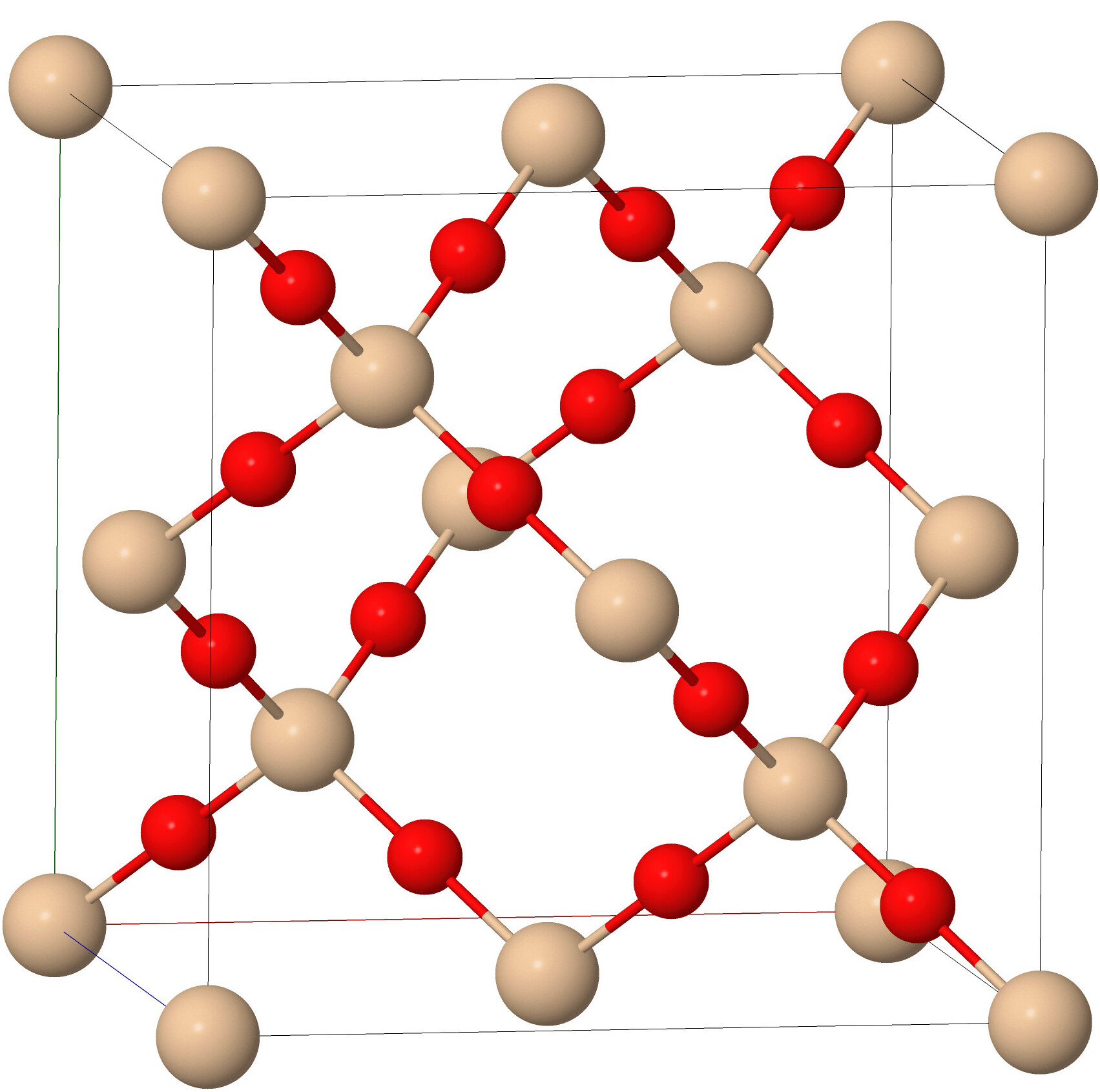
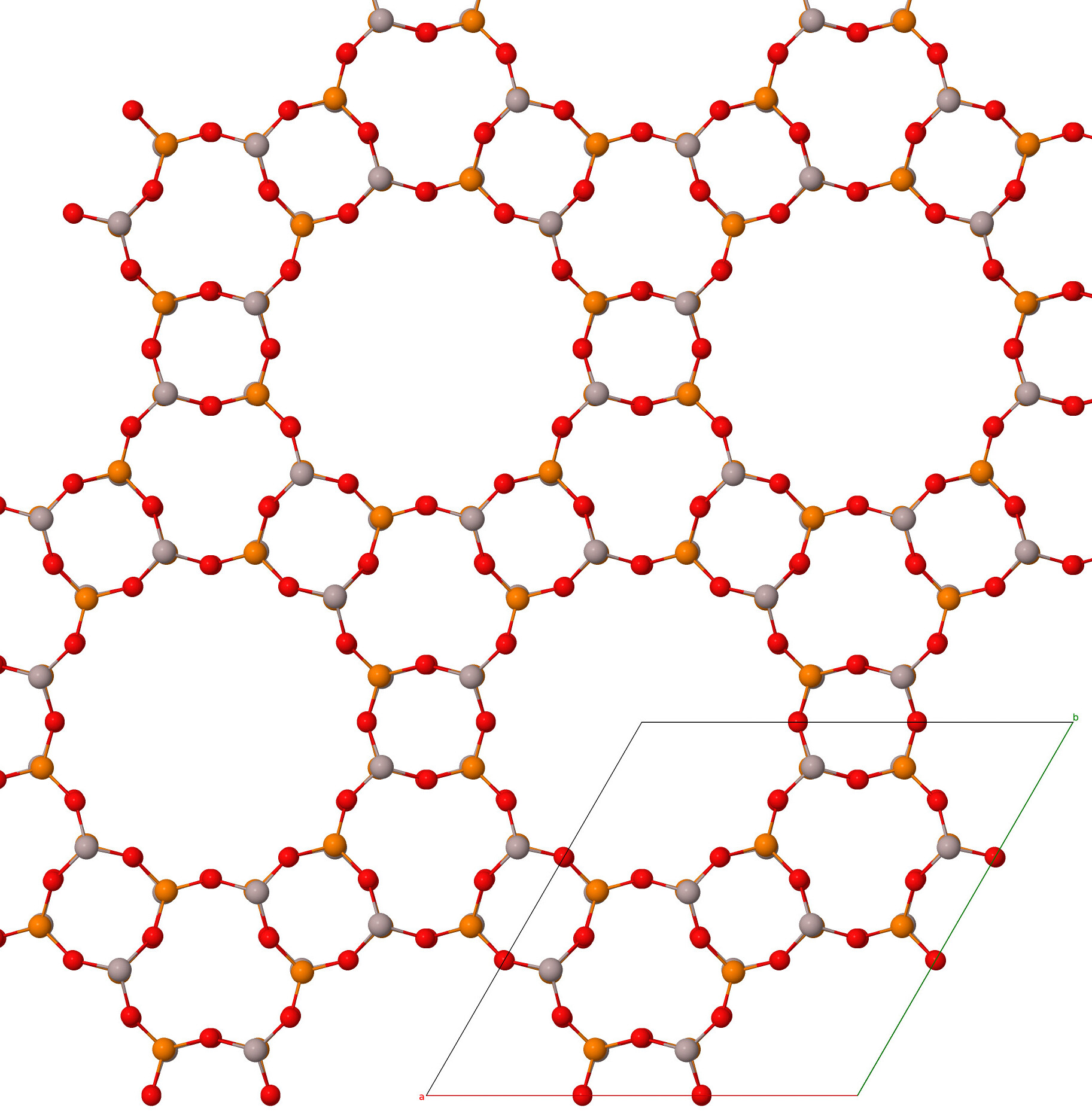
Right: The structure of AlPO$_{4}$-5 seen looking down the z-axis of the crystal. The parallelogram shows one unit cell. The aluminum and phosphorous atoms shown are actually rows of Al-O-P-O atoms, so the metallic atoms in the rings alternate as we go down the crystal. Oxygen atoms on opposite sides of the ring are separated by distances between 9.93- and 9.98Å.
Here we will look at all of the SiO$_{2}$, AlPO$_{4}$ and related structures listed in the Encyclopedia. This is an ongoing project, so the tables below will be updated as we add structures.
SiO$_{2}$ and Related Compounds
Silica (SiO$_{2}$) consists of joined SiO$_{4}$ tetrahedra as shown in Figure 1. This gives it a remarkable flexibility in finding crystal structures. These have been divided into several groups, which we'll list here.
Quartz
Quartz is the most stable silica, commonly found as sand. Other silica forms are heated or pressurized forms and are given other names. Commonly only the two structures listed in Table 1 are called quartz. α-quartz is the ground state, which transitions to β-quartz at 573°C (Wright, 1981). There is a 10% contraction of the quartz as the β form cools to α, so cracking will occur.
Interestingly, both forms of quartz are in Sohncke Class II chiral space groups, so the mirror image of $P3_{1}21$ α-quartz is in space group $P3_{2}21$, and the mirror image of $P6_{2}22$ β-quartz is in space group $P6_{4}22$. Both forms of α-quartz (or β-quartz) have the same density, bond lengths and bond angles, so the have identical formation energies. In a given sample the structure that occurs is determined by the chirality of its surrounding environment during formation.
| Structure | AFLOW Label | Space Group | Density (gm/cm3) | Stability |
|---|---|---|---|---|
| α-quartz | A2B_hP9_152_c_a-001 | $P3_{1}21$ #152/$P3_{2}21$ #154 | 2.83 | < 806 K |
| β-quartz | A2B_hP9_180_i_d-001 | $P6_{2}22$ #180/$P6_{4}22$ #181 | 2.53 | > 806 K |
Tridymite
In tridymite the SiO$_{4}$ tetrahedra are packed into a two-layer structure (Gutiérrez-Castorena, 2010). It is found in volcanic rocks, including limestone, and has been found in meteorites. Although Wikipedia lists seven known structures, the Encyclopedia currently only has four noted by (Kihara, 1978) and listed in Table 2.
| Structure | AFLOW Label | Space Group | Density (gm/cm3) | Stability |
|---|---|---|---|---|
| low tridymite | A2B_mC144_9_24a_12a-001 | $Cc$ # 9 | 2.26 | < 373 K |
| Orthorhombic tridymite | A2B_oP72_19_12a_6a-001 | $P2_{1}2_{1}2_{1}$ #19 | 2.24 | 373 K - 433 K |
| high (α-) tridymite | A2B_oC24_20_abc_c-001 | $C222_{1}$ #20 | 2.20 | 433 K - 693 K |
| high (β-) tridymite | A2B_hP12_194_cg_f-001 | $P6_{3}/mmc$ #194 | 2.18 | > 693 K |
Cristobalite
Cristobalite contains a three-layer structure of SiO$_{4}$ tetrahedra, and is mostly found in volcanic rock (Gutiérrez-Castorena, 2010). We have only found reference to two forms, shown in Table 3. Like quartz, low (α) cristobalite can be in either of two chiral space groups.
| Structure | AFLOW Label | Space Group | Density (gm/cm3) | Stability |
|---|---|---|---|---|
| α cristobalite | A2B_tP12_92_b_a-001 | $P4_{1}2_{1}2$ #92/$P4_{3}2_{1}2$ #96 | 2.34 | < 530 K |
| β cristobalite | A2B_cF24_227_c_a-001 | $Fd\overline{3}m$ #227 | 2.20 | > 530 K |
Coesite
Coesite (A2B_mC48_15_ae3f_2f-001) was first synthesized by Loring Coes, Jr. in 1953 (Coes, 1953) and was later named for him (Hazen, 1999). It has since been found in meteor craters and metamorphic rocks. With a density of 2.92 gm/cm3 it is the densest form of silica known.
Keatite
Keatite (A2B_tP36_96_3b_ab-001) was originally discovered by Paul P. Keat (Keat, 1954). It has since been found in nature. It has a typical silica density of 2.52 gm/cm3. As with some other silicas, the structure is chiral, Sohncke Class II, in space groups $P4_{1}2_{1}2$ #92 or $P4_{3}2_{1}2$ #96.
Stishovite
Stishovite is a non-silica form of SiO$_{2}$ in the rutile ($C4$) structure. Each silicon atom is surrounded by six oxygen atoms, allowing for a much higher density, 4.29 gm/cm3.
Theoretical forms of silica
Over the years computer simulations have produced several hypothetical stable phases of SiO$_{2}$. The ones include in the Encyclopedia are listed in Table 4. We note that WN$_{2}$ was not originally proposed as a silica phase. Instead it is produced by placing ordered vacancies in a supercell of WN in the rock salt structure.
| Structure | AFLOW Label | Space Group | Density (gm/cm3) |
|---|---|---|---|
| Monoclinic | A2B_mP12_3_ab3e_2e-001 | $P2$ #3 | 3.19 |
| Hexagonal | A2B_hP36_177_j2lm_n-001 | $P622$ #177 | 2.27 |
| Cubic | A2B_cI72_211_hi_i-001 | $I432$ #211 | 2.63 |
| WN$_{2}$ | A2B_cI36_229_h_d-001 | $Im\overline{3}m$ #229 | 2.07 |
AlPO$_{4}$ Structures
![alpha-quartz seen along
[0001] direction](PICS/quartz.jpg)
![berlinite seen along
[0001] direction](PICS/berlinite.jpg)
Since the basic building blocks of SiO$_{2}$ and AlPO$_{4}$ (or AlO$_{2}$PO$_{2}$) are similar, we can expect similar structures to appear in both cases. This is demonstrated in Fig. 3 which shows the ground states of both systems, α-quartz and berlinite, looking down the z-axis of both crystals. The structures look remarkably similar, with berlinite having alternating aluminum and phosphorus atoms replacing the silicon atoms in quartz. Indeed, both structures appear in the same pair of enantiomorphic space groups, $P3_{1}21$ #152 and $P3_{2}21$ #154. The major difference is that the berlinite unit cell is doubled in the z-direction compared to the quartz cell, although the stacking along the z-direction is slightly different.
SiO$_{2}$-like AlPO$_{4}$ Structures
There are indeed many AlPO$_{4}$ structures analogous to the SiO$_{2}$ structures discussed above. Here we list the ones we have in the Encyclopedia. As always, we will update this as more structures are added.
Berlinite
As noted above, α-berlinite (Onac, 2007) is the ground state of AlPO$_{4}$ and it is the analog of α-quartz. As with quartz, there is a temperature driven transaction to β-berlinite, which corresponds to β-quartz. Table 5 gives more details.
| Structure | AFLOW Label | Space Group | Density (gm/cm3) | Stability |
|---|---|---|---|---|
| α-berlinite |
ABC4_hP18_152_a_b_2c-001
(prototype Alarsite, AlAsO$_{4}$) |
$P3_{1}21$ #152/$P3_{2}21$ #154 | 2.62 | < 853 K |
| β-berlinite | AB4C_hP18_181_c_k_d-001 | $P6_{2}22$ #180/$P6_{4}22$ #181 | 2.62 | > 853 K |
Tridymite
As with silica tridymite, AlPO$_{4}$ tridymite undergoes several phase transitions as the temperature increases. Unlike in the quartz/berlinite case, the substitution of aluminum and phosphorous for silicon changes the space group, not just the cell size. Table 6 links to the structures we have in the Encyclopedia, with phase transition temperatures taken from (Graetsch, 2002).
| Structure | AFLOW Label | Space Group | Density (gm/cm3) | Stability |
|---|---|---|---|---|
| Triclinic | AB4C_aP240_1_40a_160a_40a-001 | $P1$ #1 | 2.26 | < 293 K |
| Monoclinic I | AB4C_aP240_1_40a_160a_40a-001 | $Pc$ #7 | 2.22 | ≈ 295 K |
| Orthorhombic | $P2_{1}2_{1}2_{1}$ #19 | > 295 K | ||
| Monoclinic II | AB4C_mP12_4_a_4a_a-001 | $P2_{1}$ #4 | 2.18 | 460 K - 590 K |
| Hexagonal | AB4C_hP12_186_b_bc_b-001 | $P6_{3}mc$ #186 | 1.87 | > 590 K |
Cristobalite
Like quartz/berlinite, AlPO$_{4}$ cristobalite is a one-to-one match with silica cristobalite. There are two forms, with a transition temperature of about 500 K (Hatch, 1994). The structures are described in Table 7.
| Structure | AFLOW Label | Space Group | Density (gm/cm3) | Stability |
|---|---|---|---|---|
| α | AB4C_oC24_20_a_2c_b-001 | $C222_{1}$ #20 | 2.29 | < 500 K |
| β | AB12C_cF56_216_a_h_c-001 | $F\overline{4}3m$ #216 | 2.17 | > 500 K |
Open AlPO$_{4}$ Structures
Many AlPO$_{4}$ structures, such as AlPO$_{4}$-5 (shown in Fig. 2), have an “open framework” (Zheng, 2020). Some related to zeolites, while others have even larger micropores. These pores allow the structures to function as molecular sieves (Szostak, 1989).
These microporous structures are usually labeled AlPO$_{4}$-n, where n is an integer. This practice seems to have begun with (Wilson, 1982), who list nine structures, with n = 9, 11, 14, 16, 17, 18, 20, 31, 33, stating only that “The suffix n denotes a specific structure type,” and not giving a reference to the complete list. Later (Szostak, 1989, p. 256) lists additional structures with n ≤ 47, again with no reference for the complete list. (Withers, 2005) served as our reference for AlPO$_{4}$-54, of course with no further reference. At this time n = 54 is the largest value for these structures. To make things even more confusing, AlPO$_{4}$-5 is reported in two different space groups: $P6$ #168 and $P6cc$ #184.
(Zheng, 2020) have released a database of 313 AlPO$_{4}$ structures. Most of these include molecules or metallic atoms “caught” in the AlPO$_{4}$ micropores. We will discuss such systems later.
AlPO$_{4}$ Framework Structures
Since open AlPO$_{4}$ structures have large pores, it is unsurprising that they most often include other atoms or molecules in their structures. At the moment, however, we only wish to discuss the framework structures, those consisting purely of Al/P-O$_{4}$ tetrahedra. These are difficult to obtain. Usually a sample must be heated to near its melting point in a low oxygen environment, a process called calcination. The cooled calcined structures may then need to be reheated to drive off any remaining water molecules.
Table 8 lists the framework AlPO$_{4}$ structures found in the Encyclopedia. In addition to the information we presented for previous structures, here we will include information about the largest ring. The ring size will be determined by the number of aluminum and phosphorous atoms, or, alternatively, the number of oxygen atoms. The poor size, which controls the size of molecules which can pass through the pores, is estimated by finding the smallest distance between atoms on opposite sides of the ring. As an example, the AlPO$_{4}$-5 structure shown in Fig. 2 is a 12-member ring with a pore size of 9.9Å.
| Framework | AFLOW Label | Space Group | Density (gm/cm3) | Ring Size | Pore Size (Å) |
|---|---|---|---|---|---|
| AlPO$_{4}$-5 (Theory) | AB4C_hP72_168_2d_8d_2d-001 | $P6$ #168 | 1.77 | 12 | 9.98 |
| AlPO$_{4}$-5 (Orthohombic) | AB4C_oP144_27_6e_24e_6e-001 | $Pcc2$ #27 | 1.75 | 12 | 10.01 |
| AlPO$_{4}$-5 | AB4C_hP72_184_d_4d_d-001 | $P6cc$ #184 | 1.76 | 12 | 9.98 |
| (Al,P)O$_{4}$-5 | AB2_hP72_192_m_j2kl-001 | $P6/mcc$ #192 | 1.77 | 12 | 10.04 |
| (Al,P)O$_{4}$-8 | AB2_oC216_63_f4h_ac3e4g5h-001 | $Cmcm$ #63 | 1.75 | 24 | 10.01 |
| AlPO$_{4}$-11 | AB4C_oI120_46_b2c_2b9c_b2c-001 | $Ima2$ #46 | 1.93 | 10 | 6.73 |
| (Al,P)O$_{4}$-11 | AB2_oI120_74_h2j_aef2i3j-001 | $Imma$ #74 | 1.93 | 10 | 6.65 |
| AlPO$_{4}$-18 | AB4C_mC144_15_3f_12f_3f-001 | $C2/c$ #15 | 1.50 | 8 | 6.46 |
| (Al,P)O$_{4}$-25 (High Temperature) | AB2_oC72_67_mo_cgilno-001 | $Cmme$ #67 | 2.01 | 8 | 5.70 |
| AlPO$_{4}$-35 | AB4C_hR36_148_f_4f_f-001 | $R\overline{3}$ #148 | 2.77 | 8 | 6.53 |
| AlPO$_{4}$-41 | AB4C_mP60_4_5a_20a_5a-001 | $P2_{1}$ #4 | 1.93 | 10 | 7.06 |
| AlPO$_{4}$-53 (B) | AB4C_oP144_61_3c_12c_3c-001 | $Pbca$ #61 | 2.01 | 8 | 6.62 |
| AlPO$_{4}$-53 (C) | AB4C_mC72_5_3c_12c_3c-001 | $C2$ #5 | 2.15 | 8 | 3.79 |
| (Al,P)O$_{4}$-54 | AB2_hP108_193_kl_fg2ijl-001 | $P6_{3}/mcm$ #193 | 1.46 | 18 | 15.01 |
AlPO$_{4}$ Framework + Interstitial Molecules
The AlPO$_{4}$ framework structures are interesting because the can served as molecular sieves or as reservoirs of atoms and molecules. While calcination can often remove these atoms, in some cases this causes a structural transformation, as when AlPO$_{4}$-21 becomes AlPO$_{4}$-25 (Richardson, 1999)).
Table 9 lists structures of this type found in the Encyclopedia. The given density, ring, and pore sizes are for the framework structure, exclusive of any added molecules.
| Framework | Full Formula | AFLOW Label | Space Group | Density (gm/cm3) | Ring Size | Pore Size (Å) |
|---|---|---|---|---|---|---|
| AlPO$_{4}$-5 | (AlPO$_{4}$)$_{6}$·NC$_{9}$ | A6B18CD24E6_hP110_184_d_3d_a_4d_d-001 | $P6cc$ #184 | 1.76 | 12 | 9.91 |
| AlPO$_{4}$-15 | (AlPO$_{4}$)$_{2}$(OH)(H$_{2}$O)$_{2}$·NH$_{4}$ | A2B9CD11E2_mP100_14_2e_9e_e_11e_2e-001 | $P2_{1}$/c #14 | 1.84 | 8 | 5.37 |
| AlPO$_{4}$-17 | (AlPO$_{4}$)$_{9}$(O$_{2}$)$_{9}$O | A9B55C9_hP146_176_hi_a2h8i_hi-001 | $P6_{3}$/m #176 | 1.60 | 8 | 6.00 |
| AlPO$_{4}$-21 | (AlPO$_{4}$)$_{3}$(OH)·1.33(N$_{2}$C$_{7}$H$_{21}$ | A3B4CDE13F3_mP100_14_3e_4e_e_e_13e_3e-001 | $P2_{1}/c$ #14 | 1.85 | 8 | 6.16 |
| AlPO$_{4}$-53 (A) | (AlPO$_{4}$)$_{24}$·8.5(CH$_{3}$NH$_{2}$)·14(H$_{2}$O) | A3BCD14E3_oP176_19_6a_2a_2a_28a_6a-001 | $P2_{1}2_{1}2_{1}$ #19 | 1.98 | 8 | 6.66 |
Structures related to AlPO$_{4}$
This is a list of structures in the Encylopedia that are based on AlPO$_{4}$ but do not fit in any of the preceding categories. In practice, this means compounds built on AlPO$_{4}$ with other molecules. This does not include AlPO$_{4}$-n type structures, which are detailed in Table 9.
| Structure | AFLOW Label | Space Group |
|---|---|---|
| Variscite 10 AlPO$_{4}$·(H$_{2}$O)$_{2}$ | AB4C6D_oP96_61_c_4c_6c_c-001 | $Pbca$ #61 |
References
- L. Coes, Jr., A New Dense Crystalline Silica, Science 118 (3057), 131-132 (1953). DOI: 10.1126/science.118.3057.131
- W. A. Dollase, The crystal structure at 220°C of orthorhombic high tridymite from the Steinbach meteorite, Acta Cryst. B 23, 617-623 (1967). DOI: 10.1107/S0365110X67003287
- W. A. Dollase and W. H. Baur, The superstructure of meteoritic low tridymite solved by computer simulation, American Mineralogist 61, 971-978 (1976). URL: AM61_971.pdf
- H. A. Graetsch, Monoclinic AlPO$_{4}$ tridymite at 473 and 463 K from X-ray powder data, Acta. Cryst. C 58, i18 (2002). DOI: 10.1107/S0108270101015773.
- Ma. del Carmen Gutiérrez-Castorena and William R. Effland, Pedogenic and Biogenic Siliceous Features, in Interpretation of Micromorphological Features of Soils and Regoliths, G. Stoops, V. Marcelino and F. Mees, eds. (Elsevier, 2010). DOI: 10.1016/B978-0-444-53156-8.00021-0
- D. M. Hatch, S. Ghose and J. L. Bjorkstam, The $\alpha$-$\beta$ phase transition in AlPO$_{4}$ cristobalite: Symmetry analysis, domain structure and transition dynamics Phys. Chem. Minerals 21, 67 (1994). DOI: 10.1007/BF00205217
- R. M. Hazen, The Diamond Makers, ch. 5. (Cambridge University Press, 1999), ISBN 978-0-521-65474-6. URL: https://books.google.com/books?id=fNJQok6N9_MC&pg=PA91#v=onepage&q&f=false.
- T. Hirose, K. Kihara, M. Okuno, S. Fujinami and K. Shinoda, T. Hirose and K. Kihara and M. Okuno and S. Fujinami and K. Shinoda, J. Mineral. Petrol. Sci. 100, 55-69 (2005). DOI: 10.2465/jmps.100.55
- P. P. Keat, A New Crystalline Silica, Science 120, 328-330 (1954). DOI: 10.1126/science.120.3113.328
- K. Kihara, Thermal change in unit-cell dimensions, and a hexagonal structure of tridymite, Z. Krystallogr. 148, 237–253 (1978). DOI: 10.1524/zkri.1978.148.3-4.237
- G. J. Klap, H. van Koningsveld, H. Graafsma and A. M. M. Schreurs, Microporous and Mesoporous Materials 38, 403 (2000). DOI: 10.1016/S1387-1811(00)00161-X.
- H. N. Ng and C. Calvo, X-ray study of the α-β transformation of berlinite (AlPO$_{4}$), Can. J. Phys. 54, 638 (1976). DOI: 10.1139/p76-070.
- B. P. Onac and H. S. Effenberger, Re-examination of berlinite (AlPO$_{4}$) from the Cioclovina Cave, Romania, American Mineralogist 92, 1998 (2007). ICSD: 418006. DOI: 10.2138/am.2007.2581
- D. R. Peacor, High-temperature single-crystal study of the cristobalite inversion, Z. Krystallogr. 138, 274-298 (1973). DOI: 10.1524/zkri.1973.138.1-4.274
- J. J. Pluth, J. V. Smith, and J. J. Faber, Crystal structure of low cristobalite at 10, 293, and 473 K: Variation of framework geometry with temperature, J. Appl. Phys. 57, 1045–1049 (1985). DOI: 10.1063/1.334545"
- J. W. Richardson, J. V. Smith and J. J. Pluth, AlPO$_{4}$-25: framework topology, topotactic transformation from AlPO$_{4}$-21, and high-low displacive transition, J. Phys. Chem. 94, 3365-3367 (1990). DOI: 10.1021/j100372a002
- R. Szostak, Molecular Sieves: Principles of Synthesis and Identification, Van Nostrand Reinhold Catalysis Series (Springer Science+Business Media, LLC, New York, 1989). DOI: 10.1007/978-94-010-9529-7
- Stephen T. Wilson, Brent M. Lok, Celeste A. Messina, Thomas R. Cannan, and Edith M. Flanigen Aluminophosphate molecular sieves: a new class of microporous crystalline inorganic solids, J. Am. Chem. Soc. 104, 1146-1147 (1982). DOI: 10.1021/ja00368a062
- R. L. Withers and Y. Lin, A coupled electron diffraction and rigid unit mode (RUM) study of the crystal chemistry of some zeotypic AlPO$_{4}$ compounds, J. Solid State Chem. 178, 2647 (2005). DOI: 10.1016/j.jssc.2005.06.003.
- A. F. Wright and M. S. Lehmann, The Structure of Quartz at 25 and 590$^\circ$C Determined by Neutron Diffraction, J. Solid State Chem. 36, 371–380 (1981). DOI: 10.1016/0022-4596(81)90449-7
- R. W. G. Wyckoff, The crystal structure of the high temperature form of cristobalite (SiO$_{2}$), Am. J. Science, 9, 448-459 (1925).
- C. Zheng, Y. Li and J. Yu, Database of open-framework aluminophosphate structures, Sci. Data 7, 107 (2020). DOI: 10.1038/s41597-020-0452-4 Database: (Li, 2020).
Resources
This is a list of resources mentioned in the text:
- The Database of Zeolite Structures provides zeolite framework structural information. This collects many of the AlPO$_{4}$-n structures referred to above.
- Y. Li, J. Yu and C. Zheng have released a Database of Open-Framework Aluminophosphate Structures (2020) including 313 AlPO$_{4}$ and related structures. Most are not frameworks, but include molecules or metallic impurities. They do include CIFs for each structure.